
Robotic-Assisted Joint Replacement
Precision Meets
Personalized Surgery
Powered by the CORI® Surgical System
Dr. Fox uses the CORI Surgical System from Smith+Nephew to assist with personalized hip and knee replacement. The system creates a three-dimensional model of the patient's anatomy during surgery and provides real-time information to help plan bone preparation, implant positioning, and soft-tissue balancing.
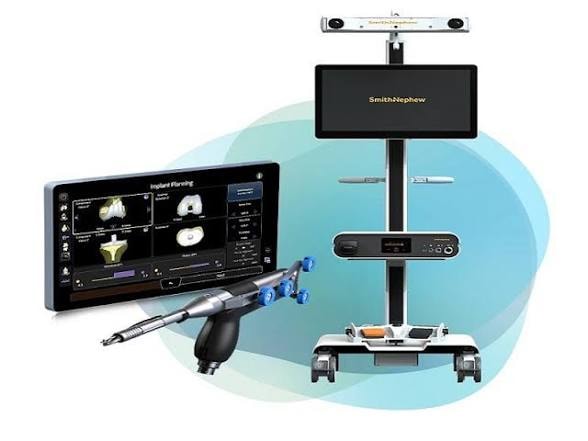
CORI® Robotic Surgery System — Smith+Nephew
3D Smart Mapping
Image-free technology maps the patient's anatomy in the operating room.
Personalized Planning
Surgical planning can be adjusted to the patient's individual anatomy and deformity.
Real-Time Balancing
Intraoperative information helps assess alignment and ligament balance throughout the procedure.
Precision Bone Preparation
The handheld robotic system assists with controlled bone preparation with accuracy and consistency.
Procedures
What CORI Is Used For
Dr. Fox uses the CORI system across four procedure types — from straightforward primary replacements to complex revision cases where anatomy is often compromised.
Primary Total Knee Replacement
CORI maps the knee anatomy intraoperatively and guides bone preparation to help Dr. Fox plan implant sizing, alignment, and soft-tissue balance for each patient.
Partial (Unicompartmental) Knee Replacement
When only one compartment of the knee is affected, CORI assists with precise bone preparation to fit the unicompartmental implant while preserving healthy tissue.
Total Hip Replacement
CORI provides real-time guidance during hip replacement to help Dr. Fox optimize cup positioning, leg length, and offset — factors that influence stability and function.
Revision Knee Replacement
CORI is FDA-cleared for revision knee arthroplasty — one of the few robotic systems with this indication. It maps bone loss and deformity intraoperatively to assist with complex reconstruction.
FDA-cleared for revision knee — a distinction few robotic systems carry
What This Means for You
What does robotic-assisted surgery mean for you?
It's important to understand: the robot does not perform your surgery. Dr. Fox does.
The CORI system is a surgical tool that provides additional information and control during the procedure. Dr. Fox remains responsible for surgical planning, decision-making, implant positioning, and execution.
- FDA-cleared for hip and knee replacement
- No pre-operative CT scan required
- Surgeon remains in full control at all times
- Used in hundreds of thousands of procedures globally
- Compatible with Smith+Nephew JOURNEY™ II and LEGION™ implant systems
Revision Knee Replacement
Robotic Guidance for the Most Complex Cases
Revision knee replacement — replacing a failed prior implant — is among the most technically demanding procedures in orthopedic surgery. Bone loss, altered anatomy, scar tissue, and the need for specialized implants make planning and execution significantly more complex than a primary case.
The CORI Surgical System is FDA-cleared for robotic-assisted revision knee arthroplasty — a distinction that few robotic platforms carry. It provides intraoperative 3D mapping of bone defects and assists Dr. Fox with the planning and execution of complex revision reconstructions.
Intraoperative 3D Mapping
CORI maps bone loss, deformity, and remaining anatomy in real time — giving Dr. Fox a detailed picture of what he is working with before making any cuts.
Complex Implant Planning
The system assists with planning for augments, stems, and constrained implants that are often required when primary implants have failed or bone stock is compromised.
Alignment in Difficult Anatomy
Scar tissue, prior bone cuts, and altered anatomy make revision surgery technically demanding. CORI provides real-time guidance to help restore alignment and stability.
Personalized Bone Mapping
CORI creates a 3D model of the patient's anatomy intraoperatively — no pre-op CT scan required — giving Dr. Fox real-time information to guide implant positioning and bone preparation.
Handheld Robotic Precision
The handheld robotic handpiece guides Dr. Fox in real time, ensuring bone preparation stays within the pre-planned boundaries for optimal implant fit.
Proven Implant Longevity
Accurate implant positioning reduces wear and the risk of early failure, supporting the long-term survival rates Dr. Fox discusses with every patient.
No Pre-Op CT Required
Unlike some robotic systems, CORI builds its bone model during surgery — saving you time, cost, and radiation exposure before your procedure.
Smith+Nephew Technology
CORI is developed by Smith+Nephew, a global leader in orthopedic innovation with decades of research behind their hip and knee implant systems.
Revision Knee Planning Software
CORI includes dedicated revision knee software that maps complex bone loss and deformity intraoperatively — giving Dr. Fox precise guidance during the more demanding revision setting where anatomy is often compromised.
Common Questions
Robotic Surgery FAQ
Is robotic surgery safe?
Yes. The CORI system is FDA-cleared and has been used in hundreds of thousands of procedures worldwide. Dr. Fox remains in complete control at all times — the robot assists and guides, but never acts independently.
Does robotic surgery cost more?
Most major insurance plans cover robotic-assisted joint replacement the same as conventional surgery. Our team will verify your benefits before your procedure.
Is CORI used for both hip and knee replacement?
Yes. Dr. Fox uses the CORI system for primary total knee replacement, unicompartmental knee replacement, and total hip replacement.
Do I need a CT scan before robotic surgery with CORI?
No — that is one of the key advantages of CORI. The system builds its bone model intraoperatively using optical tracking, eliminating the need for a pre-operative CT scan.
Ready for a More Precise Joint Replacement?
Dr. Fox is one of Middle Georgia's only fellowship-trained joint replacement surgeons using the CORI robotic system.